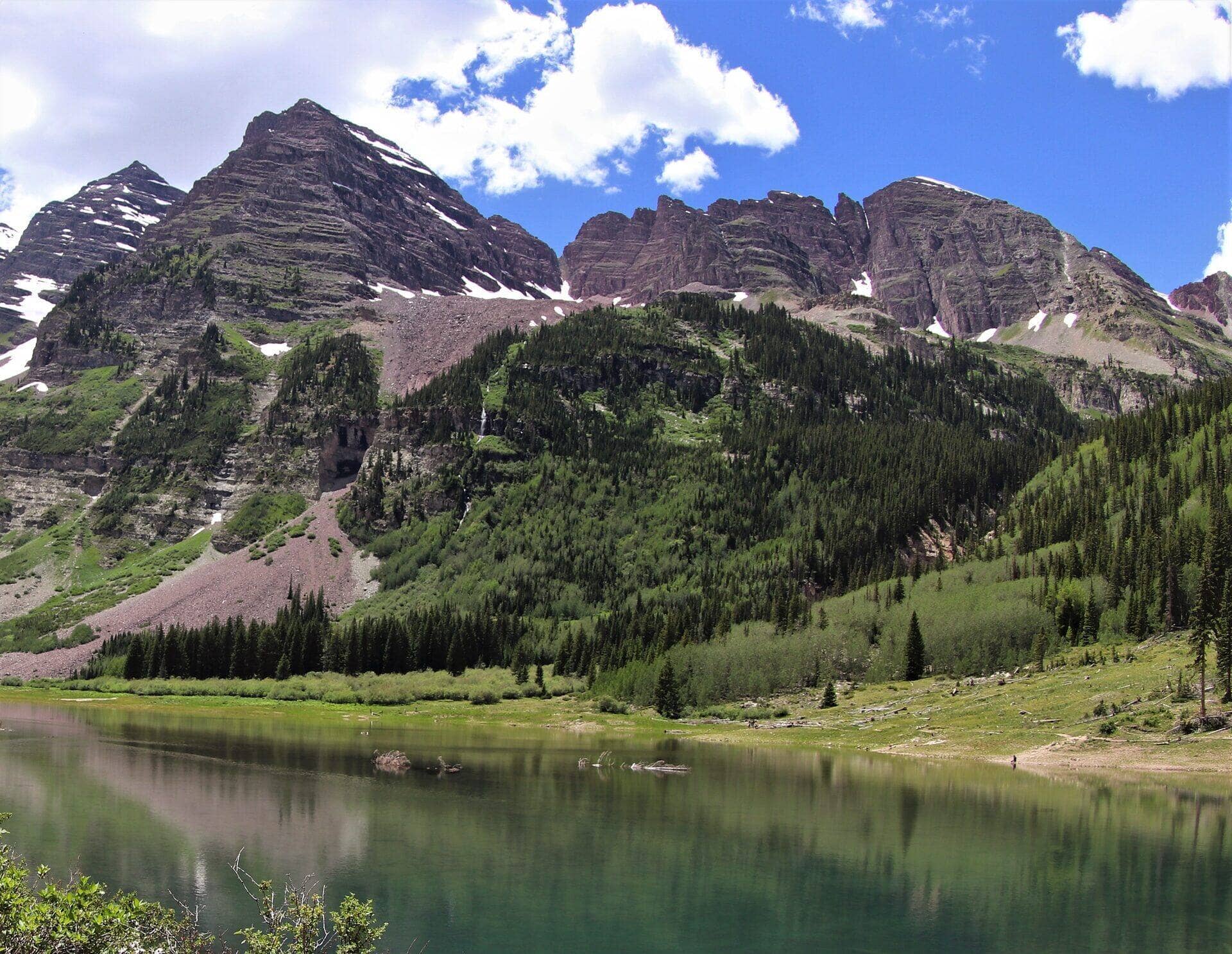
Snowmass Mountain is the Elk Range's backpacking fourteener, a 14,098-foot peak whose standard route starts with an 8-mile walk to Snowmass Lake, one of the finest camps in Colorado, and finishes with a Class 3 ridge above the big snowfield that gives the mountain its name.
Standard Route
From the Snowmass Creek trailhead at 8,400 feet, follow the trail 8.3 miles up Snowmass Creek, past the log jam crossing at the beaver ponds, to Snowmass Lake at 10,980 feet. From camp, work around the lake's west shore through willows, then climb the steep slope above to the snowfield. Ascend the snowfield or, late in summer, the talus beside it to the saddle on the summit ridge, then follow the ridge south on Class 3 rock to the summit. Total: 22 miles round trip and 5,800 feet of gain over two or three days.
What to Expect
The lake approach is long but gentle, and the willow crossing at the lake's end is the part people curse. The snowfield is the route's character: firm in the morning and soft by noon, it needs an axe and possibly crampons until August, after which it becomes loose talus. The summit ridge is solid Class 3 with exposure on the west side. The S Ridge route from Lead King Basin near Marble is the shorter alternative with a rougher road and more scrambling.
Access & Logistics
From Snowmass Village, follow Divide Road and Snowmass Creek Road to the trailhead; passenger cars manage it. Pitkin County and the Forest Service are rebuilding the Snowmass Creek trailhead and parking from August through November 2026, so parking is limited and vehicles left along the access road are ticketed and towed; check the White River National Forest alerts before you go. Overnight camping at Snowmass Lake requires a permit from Recreation.gov under the Maroon Bells-Snowmass Wilderness reservation system, released in advance and gone within minutes for summer weekends. Day trips need no permit but are 22 miles.
When to Climb
July through September. The snowfield is the reason for an early-summer trip and the reason to carry snow gear; by late August it is mostly gone and the talus is worse. Storms build over the Elks by early afternoon in July and August, and the summit is two to three hours from the lake, so climb at first light.
Camping, Permits, and Nearby
Snowmass Lake has designated campsites, no fires, and a bear canister or hang requirement; the camp is worth the trip even without the summit. Aspen and Snowmass Village have every service. Capitol Peak, one drainage north, shares the permit system and none of the mercy; Castle Peak is the Elk fourteener for a moderate day.
Gear Notes
Ice axe and crampons or microspikes through July, helmet, boots, poles for the approach, a filter, and a bear canister. A 30-meter rope is worth carrying for the ridge with a mixed party.
Related Reading
Planning a Snowmass Mountain climb? Get the prep checklist.
Free PDF — pre-climb fitness, gear, weather decision tree. Plus weekly Colorado trail picks.
We respect your inbox. Unsubscribe anytime.